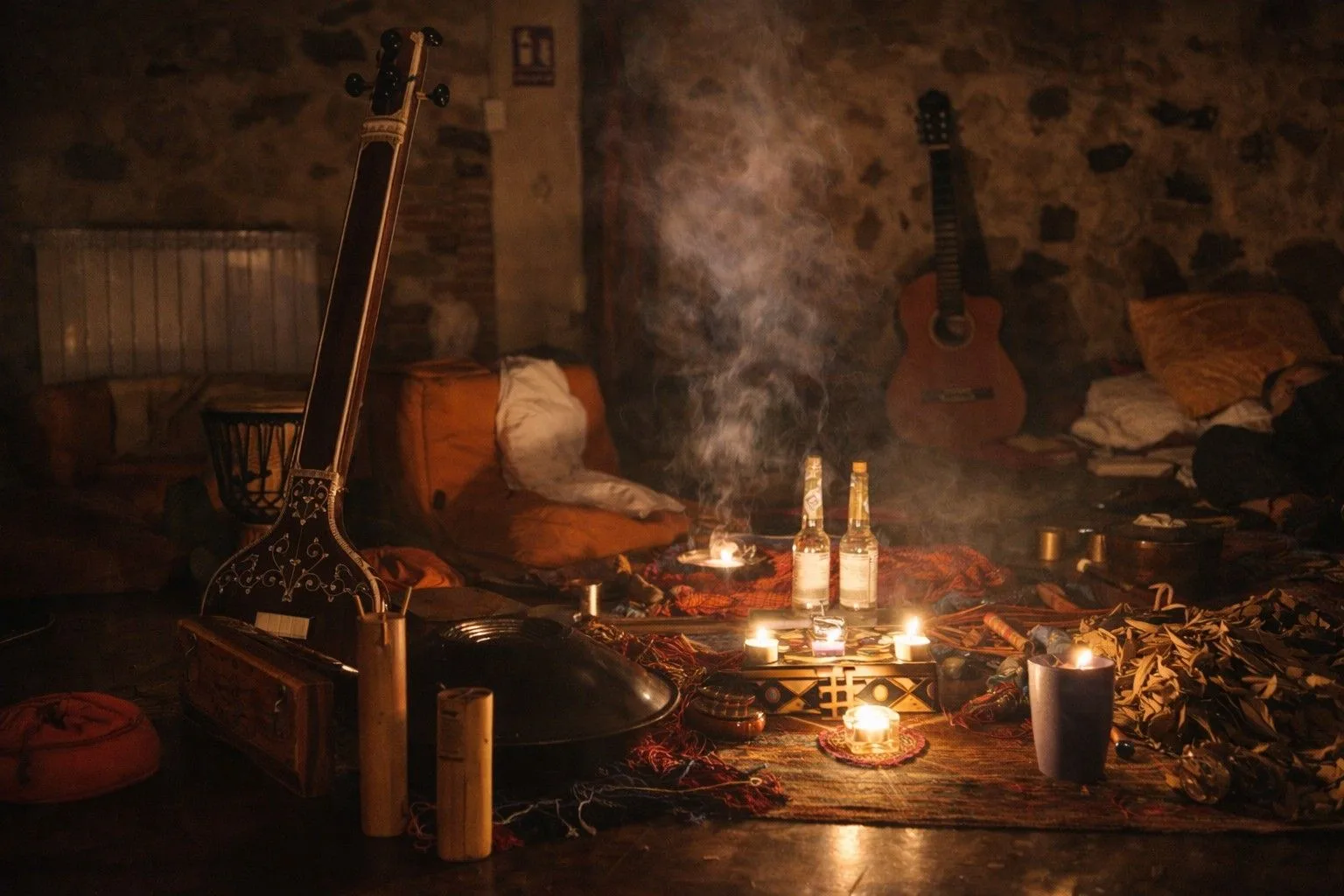
People often ask what an ayahuasca ceremony is like.
And every time, the most honest answer is the same: it cannot really be explained.
Not because people want to sound mysterious.
Not because they want to make it special.
But because something happens there that does not fit neatly into language.
One person said the morning after, “I have no words to say it.” Another said, “The experience cannot be described with words.” And another shared something even sharper: “The more I live, the less I want to speak… words distort this perfectly organized world.”
That is the first truth.
If you have not lived it, words can only circle around it.
They can point.
They cannot replace it.
And still, people try. Because something real happened.
In the same sharing circle, one person said they felt full of love, happiness, and desire to begin a new life. Another said they felt calm, grateful, and deeply connected. Another said they felt reborn, as if a forgotten version of themselves had come back to life.
And right beside that, someone else spoke of fear, anxiety, strong physical discomfort, and feeling trapped inside their own process. Someone needed music to stay oriented and felt lost when the music stopped. Another spoke about mental loops, unease, and leaving without the kind of certainty they were used to.
Same ceremony.
Same medicine.
Different worlds.
This is what people often misunderstand.
Ayahuasca is not one experience.
It is not one message.
It is not one emotion.
It is a space where each person meets what is true for them.
For one person, it was relief: “It was like a huge weight left me. I can breathe again.” For another, it was recognition: “I was looking outside, but I found it in myself.” For another, it was laughter, dancing, joy, and love.
But for others, it was not light at all.
It was pressure.
It was confusion.
It was memory.
It was not knowing.
One participant said, “I still don’t know what conclusion to draw from it.” Another said, “I don’t leave with a message or an answer, but I can say it was a journey.”
That matters.
Because too many people still speak about medicine as if it always gives clean clarity.
Sometimes it does not.
Sometimes it gives intensity before meaning.
Sometimes it brings the body forward before the mind understands.
Sometimes it gives you something you cannot package into a lesson by the next morning.
And sometimes what comes is very concrete.
One person described seeing the face of the person who had abused them and, for the first time, being able to say, “It was not my fault.” Another spoke about years of not crying because crying felt like becoming a burden, and how anger became the only way to be seen.
Another participant revisited family history, grief, and the logic that shaped them: if I do not cry, I do not cause pain to others. Another spoke of finally understanding why they are the way they are, why they behave the way they do, and how some things are not forgotten — they are lived with differently.
This is also ayahuasca.
Not only beauty.
Not only revelation.
Not only “love and light.”
Sometimes it is the body speaking in a language the mind cannot dominate.
One person said the first night felt like a rollercoaster drop, physical and visual, and later turned into panic tied to work stress, fear, tachycardia, and the feeling of being unable to get out. Another said they felt as if their whole body was disordered. Another described intense discomfort that gave way, later, to something softer and more open.
And then, in the middle of all of that, there were also stories of surrender.
One person realized that in life they move between resistance and pushing, and that real flow is neither. Another said that when they stopped resisting and let the process be what it was, something softened. Another described the message very clearly: going through discomfort through surrender, and that once surrender appeared, a kind of lightness came back into the body.
That is closer to the truth than any polished explanation.
Not that ayahuasca “gives” peace.
But that it can show you exactly where you are still fighting life.
There were also moments in the circle that said something equally important: what happens there is not supposed to be turned into quick certainty.
The facilitator explicitly said not to share too much too quickly, because if you show the seeds too early, they do not germinate. Let them settle. Let them digest. Let them become fruit first.
That too is part of the medicine.
Not just what happens during the night, but what happens after:
the slowing down, the tenderness, the body asking for less noise, fewer people, more intimacy, fewer impulsive decisions, and more listening.
And maybe this is the most honest way I can say it:
An ayahuasca ceremony is not something you can fully describe.
You can only witness its traces.
You see it in the person who says they have no words.
You see it in the one who says they are full of love.
You see it in the one who says they are still unsettled, still processing, still trying to understand.
You see it in the one who cannot explain what happened but knows something has changed.
That is why I do not want to sell beautiful stories about it.
Because the real thing is bigger than that.
More human than that.
More uncomfortable than that.
And, at times, much more loving than that too.
I have been there enough times to know that what happens in these spaces is not about performance, not about spiritual decoration, and not about collecting exotic experiences.
It is about truth.
Sometimes that truth arrives as joy.
Sometimes as pressure.
Sometimes as memory.
Sometimes as relief.
Sometimes as silence.
And sometimes as the simple recognition that what cannot be explained can still be real.
If this kind of work speaks to something in you — not because it sounds beautiful, but because you are ready for something real — reach out.